 LUFS200D1
Liquid VFFS Sachet Filling Machine
Compact piston-pump VFFS platform for sauces, syrups, gels and other flowable products.
5–100 mlPiston pumpBack / 3-side / 4-side
View machine details
Twelve-lane VFFS system for compact, high-volume granule and small particulate sachets.
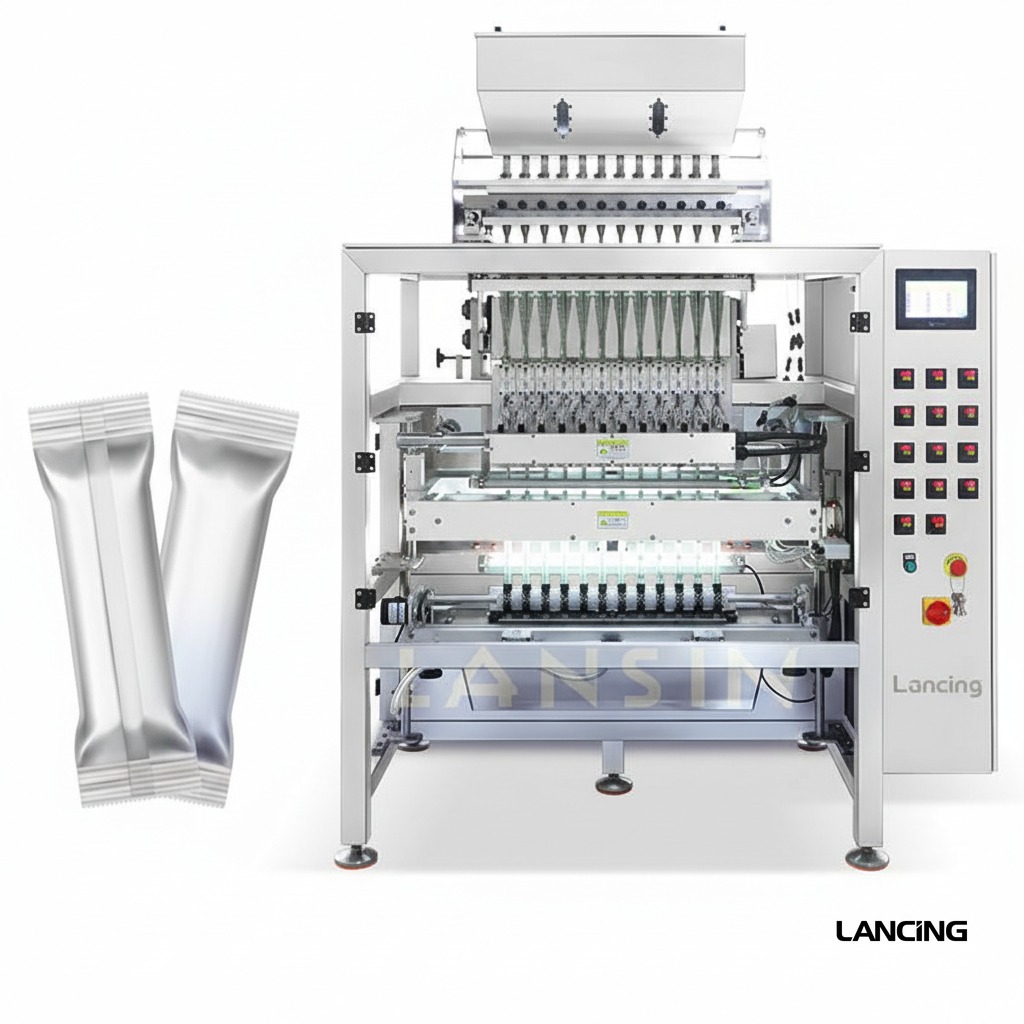
Machine overview
The LU-FSL12 is designed around throughput: twelve narrow sachets are formed and filled in parallel from a wide reel. It is particularly relevant to free-flowing, small-granule products packed in compact single portions.
Published specification
| Number of lanes | Twelve |
|---|---|
| Film type | Compatible heat-sealable composite film |
| Reference film width | Approximately 600 mm; 50 mm per lane |
| Seal style | Back seal |
| Reference bag length | 40–80 mm |
| Length tolerance reference | Approximately ±1 mm |
| Compressed air | Approximately 0.8 MPa |
| Typical products | Sugar, salt and other small free-flowing granules |
Reference figures are configuration-dependent and must be confirmed for the product, pack and utilities.
Configure the line
Performance validation
Target output and dose repeatability are affected by product flow, environmental conditions, sachet length, film sealing window, changeover and quality-control settings. Supply representative product and production film for a meaningful test.
Related machinery
LUFS200D1Compact piston-pump VFFS platform for sauces, syrups, gels and other flowable products.
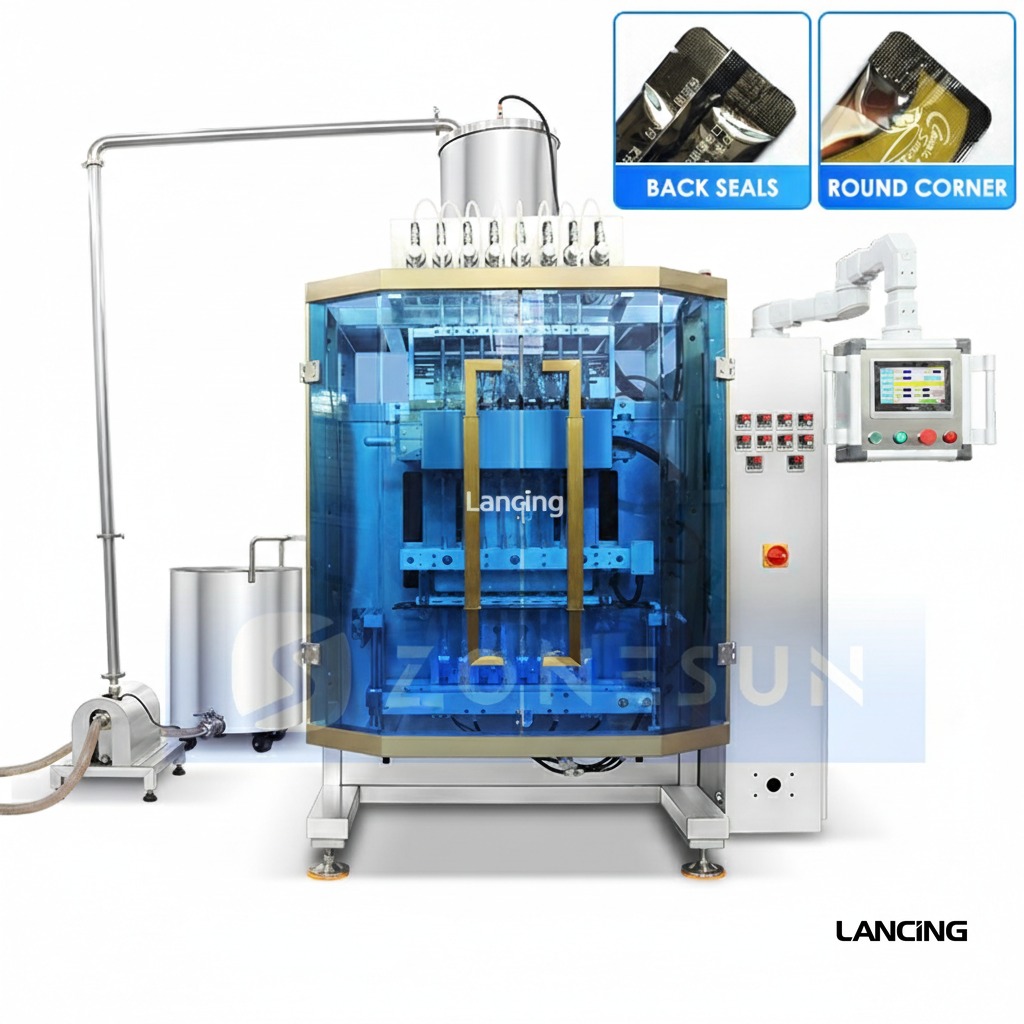 LU-FSMP8
High-output multi-lane VFFS system with independent magnetic-pump dosing for narrow liquid sachets.
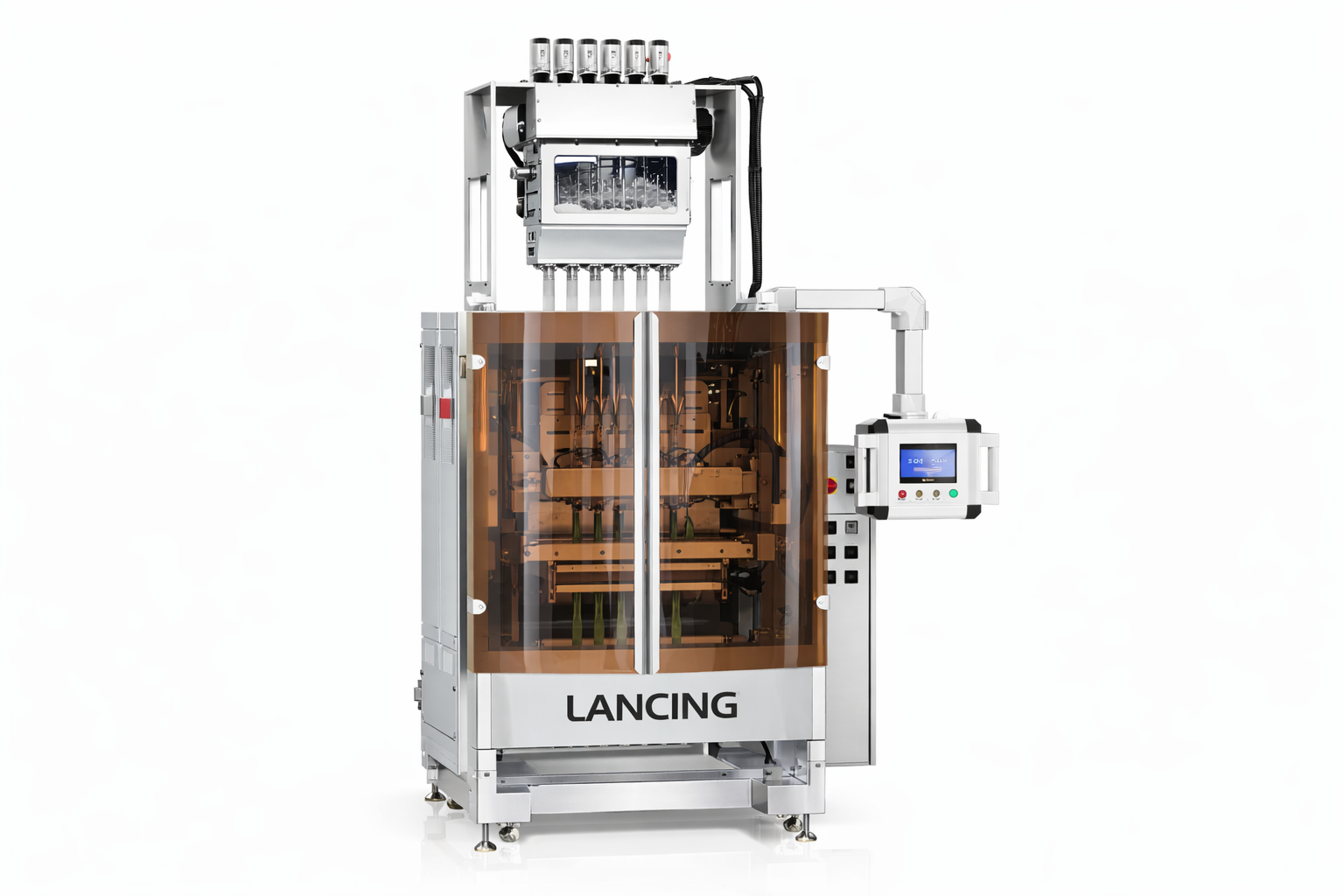 LU-FSFM6
Independent auger dosing across multiple lanes for high-output powder sachet production.
Common questions
No. Multi-lane systems work best when the product flows consistently and the sachet is narrow enough to fit the web layout. Product and film trials are essential.
The reference arrangement uses twelve lanes at approximately 50 mm per lane. Sealing margins and final sachet width must be confirmed during tooling design.
The narrow back-seal format is related to stick-pack production. Exact dimensions, seam position, cut pattern and product dose must be engineered for the application.
Tell us about your product and pack
Send the product, target dose, sachet dimensions, film and required output. Lancing Ltd will review your application and recommend a practical machinery route before a detailed quotation.
Production specification for LU-FSL12
The LU-FSL12 is presented for compact, free-flowing granule sachets. Particle dimensions, lane pitch, film registration and product fall must remain compatible across twelve channels, and every lane should be included in dose and seal checks.
Small free-flowing granules can continue to fall after the dosing command if the feed path is not controlled. Cross jaws must close only after the product has cleared the seal area, while excessive delay reduces output. The trial should therefore observe both dose consistency and trapped particles at the intended cycle.
The published web reference indicates a compact lane arrangement. Product size and the usable opening in each forming path must be checked so granules do not bridge, bounce out or damage the film and seals.
| Product distribution | Run the intended hopper and lane-feed arrangement through start-up, stable production and refill while sampling every lane. |
|---|---|
| Lane dose check | Label sachets by lane and compare the agreed weight or count criteria across the full web. |
| Seal contamination | Inspect cross seals for trapped granules and apply the agreed integrity test to samples from each lane. |
| Film registration | Check the 600 mm-class web drawing, lane pitch, back seals, print, cut and tear features using production-representative film. |
| Accepted output | Count conforming sachets and record lane rejects, product feed interruptions, normal quality checks and downstream collection. |
Larger, irregular, fragile or mixed pieces may not suit narrow twelve-lane forming paths. A compact weighing machine can trade headline output for a wider product path, easier access and a dosing principle aligned to larger target weights.
A useful trial record identifies the product and film batches, dose setting, sachet dimensions, forming and sealing parts, coding setup, operating speed, stops, rejected packs and quality checks. Retained samples should be labelled so results can be traced to the lane, recipe or test condition where relevant.
The final quotation and acceptance schedule should distinguish indicative catalogue references from the values that will be demonstrated with the agreed product, pack and utilities.
Additional buyer questions
Suitability depends on particle dimensions, shape, fragility, lane opening and dosing method. Representative product should be tested because narrow channels can bridge or damage larger pieces.
The final feed and distribution arrangement must be specified for the product. The acceptance test should reproduce normal refill and verify every lane.
It is a configuration reference, not a universal acceptance guarantee. Final print-to-cut and pack-length criteria should be agreed with the actual film and operating conditions.
A perforated or strip arrangement may be possible depending on cutting and sealing tooling. The required presentation must be shown on the web and finished-pack drawing before manufacture.
Define the project around your product and pack
Provide representative product, every required dose and sachet size, film details, accepted output, utilities, cleaning and inspection requirements. Lancing Ltd can then confirm whether the LU-FSL12 is the correct starting point and define the trial scope.
Model-specific lane assurance
Small granules can remain free-flowing while still bouncing, bridging, segregating or entering the transverse seal. Use lane-identified samples and the production feed arrangement.
Record particle range, density, fines, fragility and the hopper/refill method. Observe distribution across all lanes before and after replenishment.
Issue the numbered web drawing and verify lane pitch, back seals, artwork, code, cut and tear features with production-intent film.
Measure the agreed mass or count by lane, inspect granules in the seal, apply the integrity test and record accepted output after rejects.