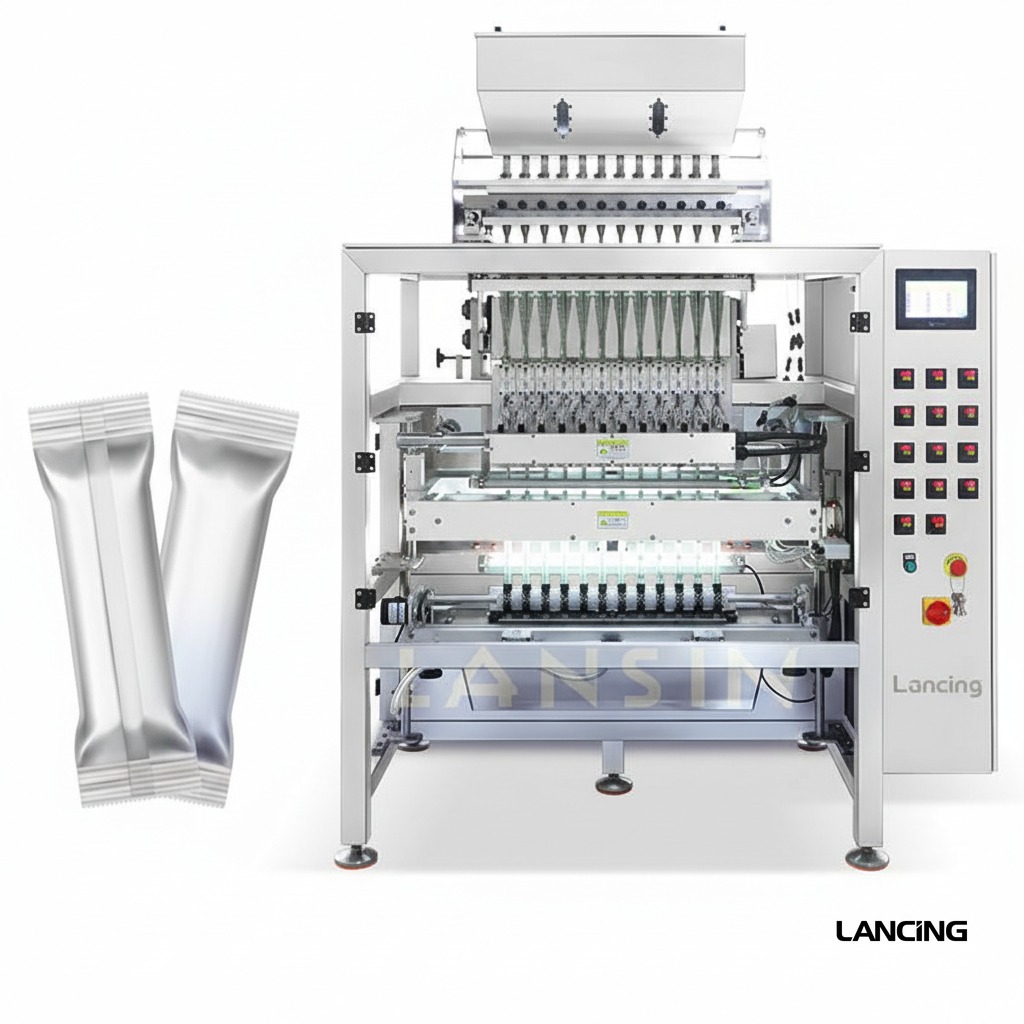
 LU-FSL12
12-Lane Granule Sachet Filling Machine
Twelve-lane VFFS system for compact, high-volume granule and small particulate sachets.
12600 mmBack seal
View machine details
Machine category
Granules are commonly dosed by weighing or volumetric measurement. The best method depends on target weight, piece size, density variation, fragility, speed and the tolerance that the finished pack must meet.
Machine options
Choose the closest starting point below. We will confirm the final model against your product, sachet, film and required output.
LU-FSL12Twelve-lane VFFS system for compact, high-volume granule and small particulate sachets.
 LU-FSK1000
Compact weigh-fill-seal machine for free-flowing granules and small production environments.
 LUFM1000
Space-efficient vertical form fill and seal machine for measured powder or granule packs.
Weighing can compensate for density variation and provides a direct mass measurement. Volumetric systems can be simple and fast for consistent products. Multihead weighing is often selected where higher speed and tighter combinations are required.
Granules can rebound from the forming tube or become trapped in the transverse seal. Chute geometry, timing, anti-static measures and sufficient settling distance protect seal quality.
Fragile pieces need low drop heights and gentle handling. Mixed products can segregate during transfer, so the hopper and feeding route should preserve the intended blend.
Specification checklist
Common questions
Examples include sugar, salt, rice, seeds, grains, beads and small free-flowing pieces. Each product still needs a flow and size assessment.
Multi-lane narrow sachet systems are normally best for small, consistent granules. Larger or irregular pieces may need a single-lane or multihead-weigher line.
Dosing time, product flow, bag length, settling time, sealing and downstream handling all contribute to the final rate.
Tell us about your product and pack
Send the product, target dose, sachet dimensions, film and required output. Lancing Ltd will review your application and recommend a practical machinery route before a detailed quotation.
Granule and particulate projects
Granules vary from uniform crystals to mixed, fragile or irregular pieces. Particle-size distribution, breakage, segregation, bulk density and the target dose determine whether a weighing, cup, counting or other dosing principle is appropriate.
State the minimum and maximum particle size, shape, fragility and any coating that can abrade or become sticky. Drop height, vibration, feeder surfaces and closing jaws should not damage the product or trap pieces in the seal. Mixed products need particular attention because components can segregate during transfer and hopper refill.
For a weighed dose, set the target, permitted variation and sample method. For counted or volumetric products, explain whether the commercial requirement is a weight, a count or a filled volume. The test must reflect normal product variation rather than a specially graded sample.
| Product range | Provide particle dimensions, density, shape, fragility, surface condition and the normal proportion of fines. |
|---|---|
| Dose and sachet | List target weights or counts, tolerance, pack dimensions, headspace and whether the product can bridge in a narrow forming tube. |
| Feed and refill | Describe upstream transfer, hopper capacity expectations and how segregation or breakage will be controlled during replenishment. |
| Film and seals | Confirm laminate, seal pattern, tear notch, registration and enough seal clearance to prevent particles entering the jaw area. |
| Trial checks | Measure dose, damaged product, seal contamination, code and registration quality, rejected packs and accepted output with normal refilling. |
Additional buyer questions
Weighing is often considered when the commercial requirement is a controlled weight and product pieces vary in size or density. The practical choice still depends on dose, speed, fragility, footprint and the way product is supplied.
It may be possible, but segregation in transfer, the hopper and the dosing system must be assessed. Samples should represent the normal mix and the trial should check whether every pack remains commercially acceptable.
Use adequate headspace, controlled drop timing, suitable forming geometry and a dosing cutoff that stops product falling before the cross jaws close. Trials should include the fastest intended running condition.
No. Lane width, particle size, dosing principle, film pitch and cleaning access can rule out a multi-lane route. Wider or irregular products may be better on a single-lane weighing system.
Retain packs from the start, stable run, refill and normal stop-restart conditions. Record dose results, product damage, seal contamination, rejected packs and the exact product and film batches.
Define the project around your product and pack
Provide particle-size range, fragility, target weight or count, sachet dimensions, film, required output and the intended product-feed method. Include mixed-product or segregation concerns so the dosing route can be selected on real conditions.
Granule-project control plan
Granules can be free-flowing while still creating dose, segregation, breakage or seal-clearance problems. Define whether the commercial result is mass, count or volume before selecting the filler.
Record particle-size range, shape, density, fragility, dust/fines and whether a blend segregates during transfer. Supply a representative batch in enough quantity to reproduce replenishment.
Compare weighing, volumetric or count-based routes against the requirement. Check product in flight, settling, drop height and any breakage before the seal closes.
Allow internal volume for the dose and headspace. Define dimension, seal, integrity, dose and code checks, with lane identity on parallel systems.
Granule-handling questions
Breakage can change appearance, piece count, bulk density, dust level and the amount of product that reaches the seal, even when the measured pack weight remains acceptable.
Inspect product before and after the feeder, weigher and drop path. Retained packs should be opened and compared with the incoming sample rather than judged only by external appearance.
Components with different size, shape or density can separate during transport, vibration, hopper residence and repeated refilling.
A correct total weight does not prove the intended component ratio. Define how the mixture is prepared, transferred and sampled, and include the longest expected run or hopper residence relevant to production.
A weigher is often considered where mass control and density variation matter, while a volumetric cup may suit a stable free-flowing product and an accepted volume-based relationship.
The choice still depends on particle fragility, target dose, required tolerance, product distribution, cleaning and cycle time. Representative trials should compare the commercial measure that will be used in production.
Identify pack samples by time and operating condition, then check weight, piece distribution, damage, fines and seal contamination against an agreed method.
For mixed or irregular pieces, use enough samples to reveal variation rather than relying on one acceptable pack. Record feeder level and refill events so outliers can be traced to the process.
Turn the answer into a testable machine brief
Include representative product, dose range, sachet dimensions, film or artwork data, required accepted output and any cleaning, coding, inspection or line-integration requirements. Lancing Ltd can then assess the machine route against the real production case.