
Choose the dosing principle from product behaviour and the commercial measure
A sachet line can only be as stable as its product feed and dosing system. The first question is whether the saleable requirement is defined by mass, volume or count, followed by how the product behaves while being stored, transferred and delivered into the pack.
Names such as liquid, powder and granule are starting categories. Viscosity, density, aeration, cohesion, particles, foaming, stringing, fragility, segregation and temperature determine the practical arrangement and the trial conditions.
Liquid and paste dosing: control feed, cut-off and seal clearance
Piston and other positive-displacement systems are common starting points for viscous liquids, sauces, gels and pastes. Pump-based routes can suit compatible lower-viscosity products. The selection still depends on chemical compatibility, product temperature, particles, foaming, pressure, refill method and whether the product drips or strings after the dose.
Nozzle geometry and closure need to keep product away from the seal zone. Trials should include start-up, normal running, pauses, restart, hopper or tank refill and end-of-batch conditions because feed pressure and product temperature can change through the run.
Powder dosing: manage bulk density, aeration and refill disturbance
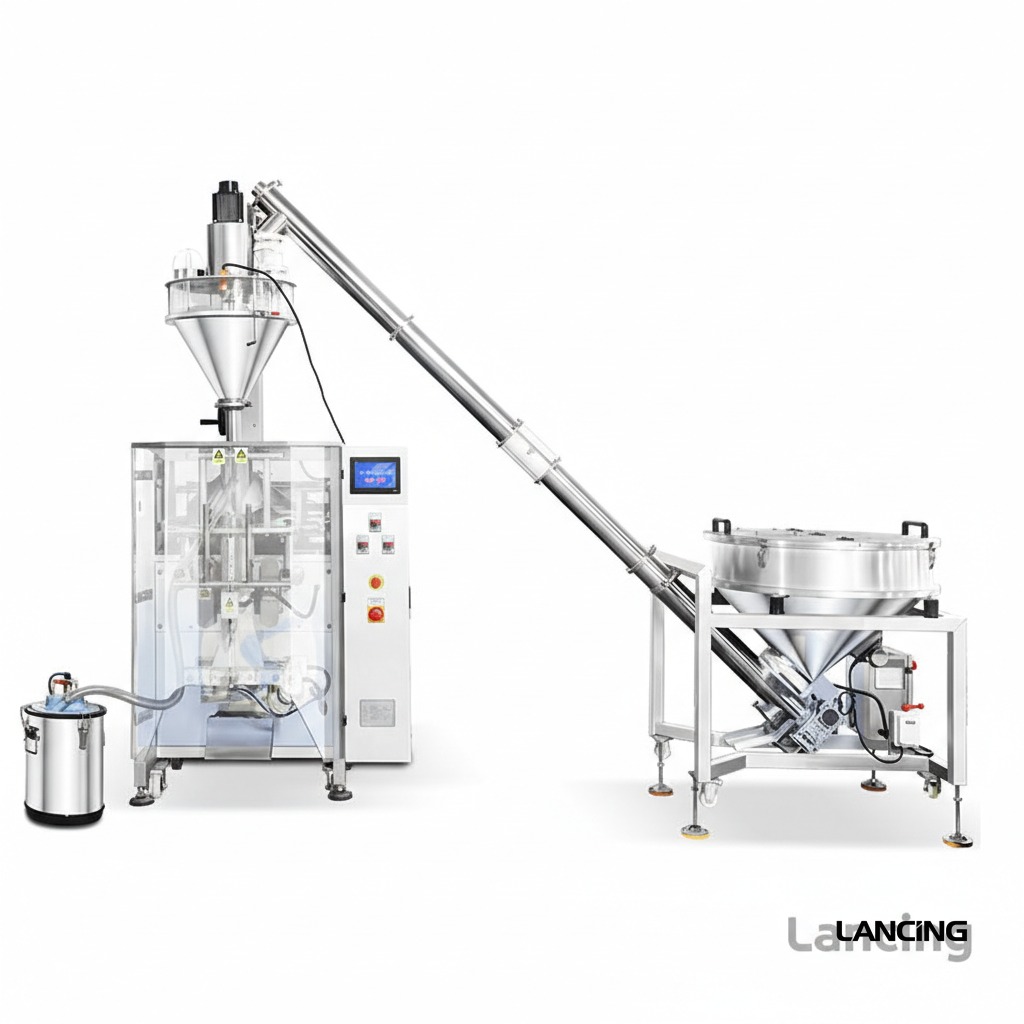
Auger dosing is a common route for fine or cohesive powders because a controlled screw movement meters product from a conditioned hopper. Screw geometry, agitation and speed must be matched to the product and dose. A volumetric result can change in mass when bulk density changes.
Provide representative powder and record bulk density in the states that occur in production. Test hopper refill, low-level operation, dust behaviour, product settling and the feed system. The transfer method can aerate or compact material differently from a hand-filled trial hopper.
Granule dosing: compare weighing, cups and count-based requirements
Free-flowing granules may be dosed by weighing, volumetric cups or another controlled method. The choice depends on whether the requirement is mass, volume or count, together with particle size, density, fragility, shape and the risk of blend segregation.
Pack volume must allow the dose to settle without obstructing the seal. Product drop height and timing can matter for fragile pieces or blends. Representative trials should check breakage, segregation and repeatability after normal replenishment.
Treat product feed and level control as part of the dosing system
The filler cannot remain repeatable when its inlet condition is uncontrolled. Define the upstream tank, pump, hopper, feeder or vacuum transfer; minimum and maximum levels; refill strategy; low-level response; and signals between the feed system and bagger.
The control sequence should prevent empty packs, overfilling after a fault and dosing while the film or jaws are not ready. Agree what the machine does after an emergency stop, guard opening, downstream stop or product-low alarm.
Specify a dosing trial that produces useful evidence
| Representative product | Use the intended formulation or a formally agreed equivalent with recorded behaviour. Identify batch, temperature and conditioning. |
|---|---|
| Nominal dose | State target mass or volume and every format to be demonstrated, including the most demanding low and high cases. |
| Measurement method | Define the instrument, sample preparation, tare method, units, resolution, sample frequency and acceptance rule. |
| Operating states | Include start-up, steady running, normal refill, low-level condition, planned pause, restart and end-of-batch where relevant. |
| Pack interaction | Check product carry-over, dust, drips, strings, settling and contamination of the seal area. |
| Evidence | Retain lane-identified or time-identified data, rejected samples, representative accepted packs and video of the declared set-up. |
Know when another dosing route should be trialled
A product that bridges, changes density, contains large particles, separates, foams or requires a strict mass result may not suit the first proposed technology. The correct response is not to force the product into a generic category; it is to test another feed, agitation, pump, screw, weighing or filling arrangement.
Machine-specific suitability and any numerical performance must come from the verified proposal and agreed trial. General dosing principles are useful for screening, but they are not a substitute for product evidence.