 LUFS200D1
Liquid VFFS Sachet Filling Machine
Compact piston-pump VFFS platform for sauces, syrups, gels and other flowable products.
5–100 mlPiston pumpBack / 3-side / 4-side
View machine details
High-output multi-lane VFFS system with independent magnetic-pump dosing for narrow liquid sachets.
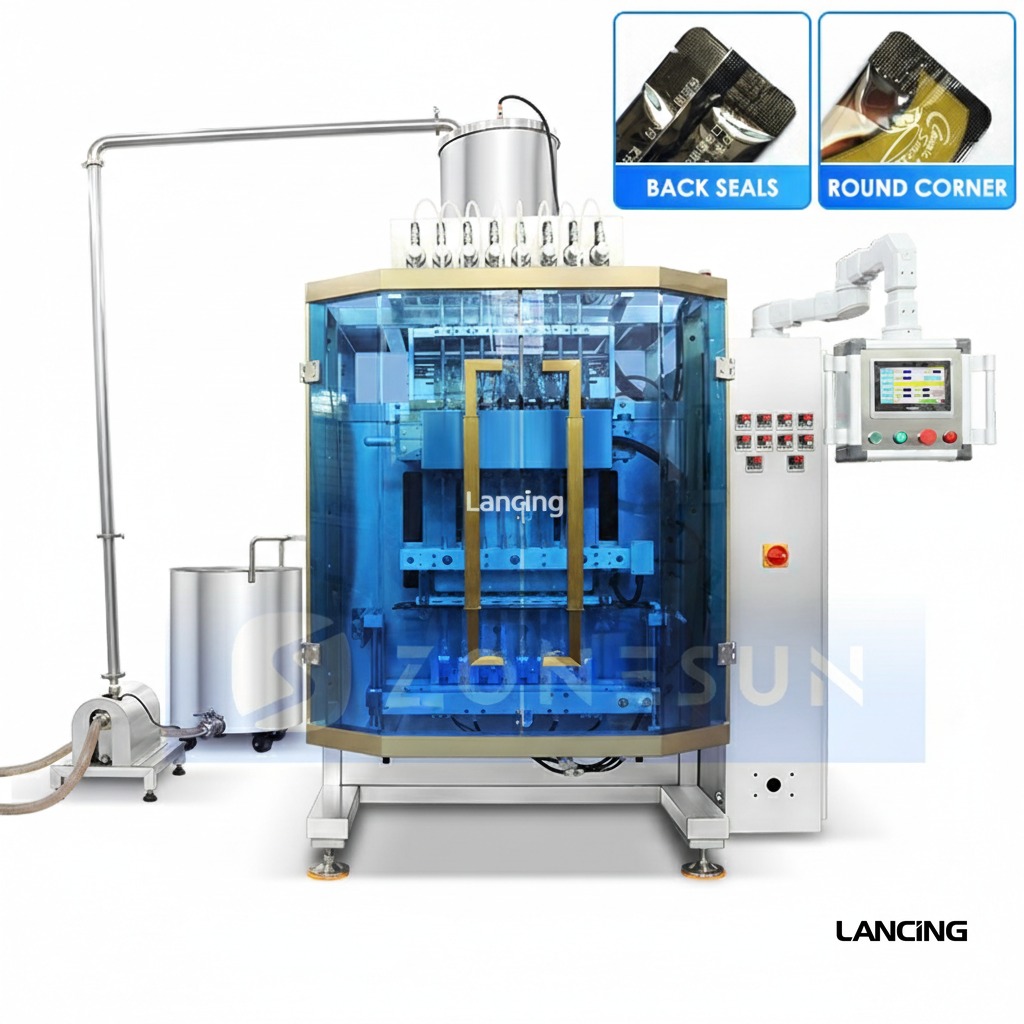
Machine overview
The LU-FSMP8 is intended for high-volume production of narrow liquid sachets. Eight dosing lanes operate in parallel, increasing output without multiplying the number of standalone machines.
Published specification
| Number of lanes | Eight |
|---|---|
| Indicative output | Approximately 25–40 sachets per minute per lane |
| Reference sachet size per lane | Length 34–150 mm; width 15–26 mm, customisable |
| Maximum film width | Approximately 500 mm |
| Seal style | Back seal with rounded-corner configuration |
| Power | Approximately 9.5 kW |
| Approximate machine size | 2100 × 1700 × 1800 mm |
| Product supply | Approximately 150 litre tank and 50 litre hopper |
| Typical laminates | OPP/CPP, PET/PE and compatible foil or paper laminates |
Reference figures are configuration-dependent and must be confirmed for the product, pack and utilities.
Configure the line
Performance validation
Target output and dose repeatability are affected by product flow, environmental conditions, sachet length, film sealing window, changeover and quality-control settings. Supply representative product and production film for a meaningful test.
Related machinery
LUFS200D1Compact piston-pump VFFS platform for sauces, syrups, gels and other flowable products.
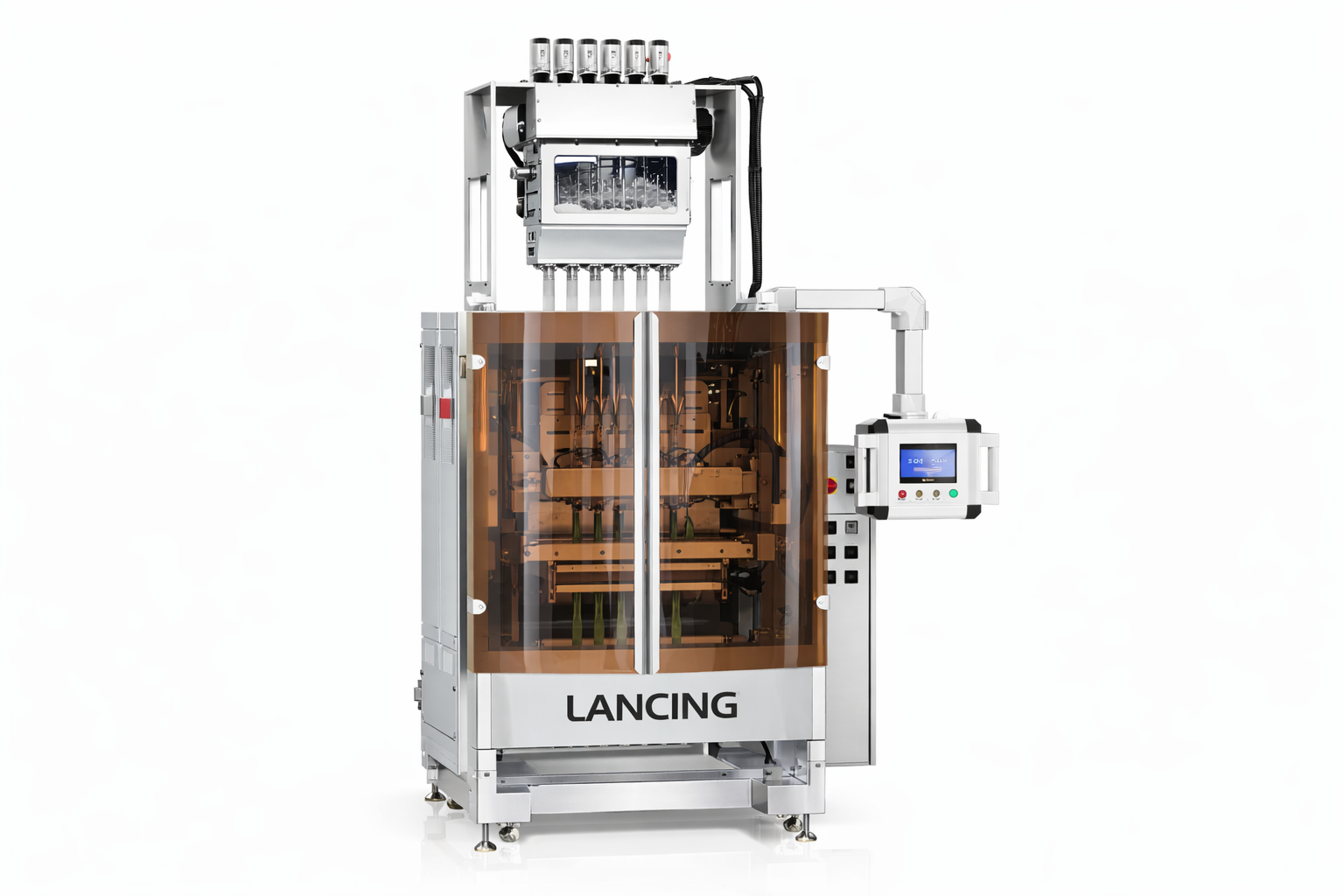 LU-FSFM6
Independent auger dosing across multiple lanes for high-output powder sachet production.
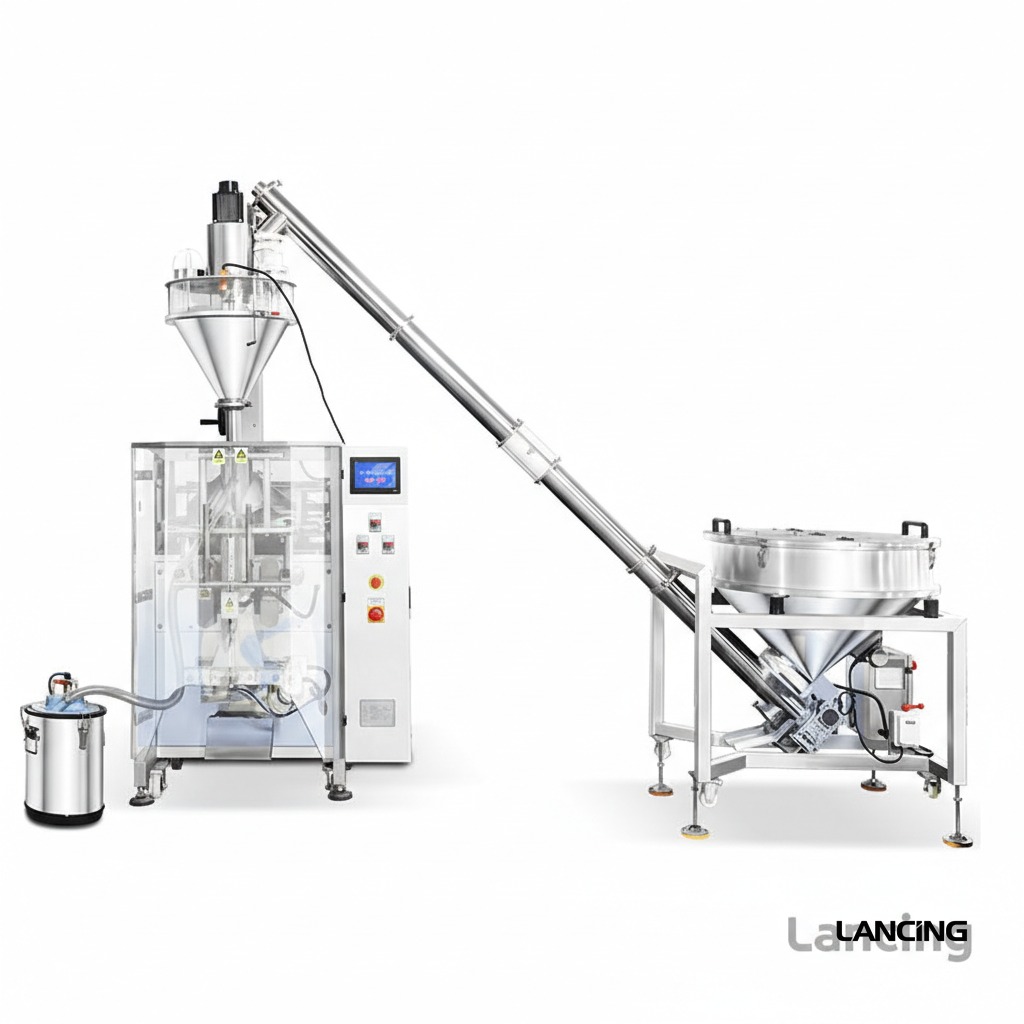 LU-FS06
Flexible single-lane auger VFFS platform for powder packs from small sachets to larger bags.
Common questions
No. The reference figure is per lane. Actual total output depends on active lanes, sachet length, film, product behaviour and quality-control requirements.
They are commonly considered for low-viscosity, compatible liquids. Product chemistry, viscosity, foaming and cleanability must be assessed before selection.
Multi-product operation may be technically possible but introduces product-feed, cleaning, control and validation complexity. It should be defined as a bespoke engineering requirement.
Tell us about your product and pack
Send the product, target dose, sachet dimensions, film and required output. Lancing Ltd will review your application and recommend a practical machinery route before a detailed quotation.
Production specification for LU-FSMP8
The eight-lane configuration is intended for narrow liquid sachets, so lane pitch, film registration, pump compatibility and lane-to-lane dose control are central. The quoted per-lane reference should be converted into accepted total output under an agreed test.
Independent dosing channels allow each lane to be adjusted, but a common supply system can still create unequal conditions if level, pressure or product composition changes. Sampling should identify every lane and should include periods after refill and stop-start events.
The total film width, lane pitch, print repeat, eye marks, back-seal position and cross cut form one artwork specification. Production film should be used to verify that the photocell and correction system hold the cut and seal in the accepted position across the entire web.
| Lane dose study | Take labelled samples from every lane at start-up, stable running, after refill and after normal adjustments. Report individual and lane-average results. |
|---|---|
| Web registration | Check print-to-seal and print-to-cut position across all lanes using production-representative registered film. |
| Seal and leak checks | Inspect longitudinal and cross seals lane by lane and apply the agreed pack-integrity test to a defined sample. |
| Product supply | Run the intended tank, hopper, manifold and refill method and observe whether product condition remains uniform across channels. |
| Accepted output | Count saleable packs and record lane-specific rejects, isolated lanes, normal inspections and downstream handling limits. |
Lower output, frequent format changes, highly viscous products or liquids with particles may favour a single-lane piston machine or another pump technology. A multi-lane layout should be justified by sustained accepted output and manageable cleaning rather than by headline speed alone.
A useful trial record identifies the product and film batches, dose setting, sachet dimensions, forming and sealing parts, coding setup, operating speed, stops, rejected packs and quality checks. Retained samples should be labelled so results can be traced to the lane, recipe or test condition where relevant.
The final quotation and acceptance schedule should distinguish indicative catalogue references from the values that will be demonstrated with the agreed product, pack and utilities.
Additional buyer questions
Report each lane separately as well as the overall result. A combined average can hide a channel that remains consistently high or low.
The lane count is tied to dosing channels, forming, sealing, web layout and cutting. Any alternative configuration must be engineered and quoted rather than assumed.
The required machine response, alarm, isolation or reject method should be agreed in the controls and acceptance specification before manufacture.
The drawing coordinates lane pitch, print repeat, back seals, cross seals, corners, tear features and cuts. It should be approved by the machine supplier, film converter and pack owner.
Define the project around your product and pack
Provide representative product, every required dose and sachet size, film details, accepted output, utilities, cleaning and inspection requirements. Lancing Ltd can then confirm whether the LU-FSMP8 is the correct starting point and define the trial scope.
Model-specific lane assurance
A combined output figure cannot show whether one dosing channel, nozzle or web position is weak. Preserve lane identity through the complete trial.
| Product distribution | Use the intended tank, hopper, manifold, refill and temperature conditions; record changes at start-up, refill, pause and restart. |
|---|---|
| Lane dose | Label and measure every lane at agreed intervals. Report individual results and the acceptance response to a weak lane. |
| Registration and code | Check print-to-seal, print-to-cut and variable-code position across the web using production-intent printed film. |
| Seal and integrity | Inspect longitudinal and transverse seals for product carry-over and apply the agreed method to lane-identified samples. |
| Accepted output | Count saleable packs while recording active lanes, rejects, normal inspection, product refill and downstream constraints. |