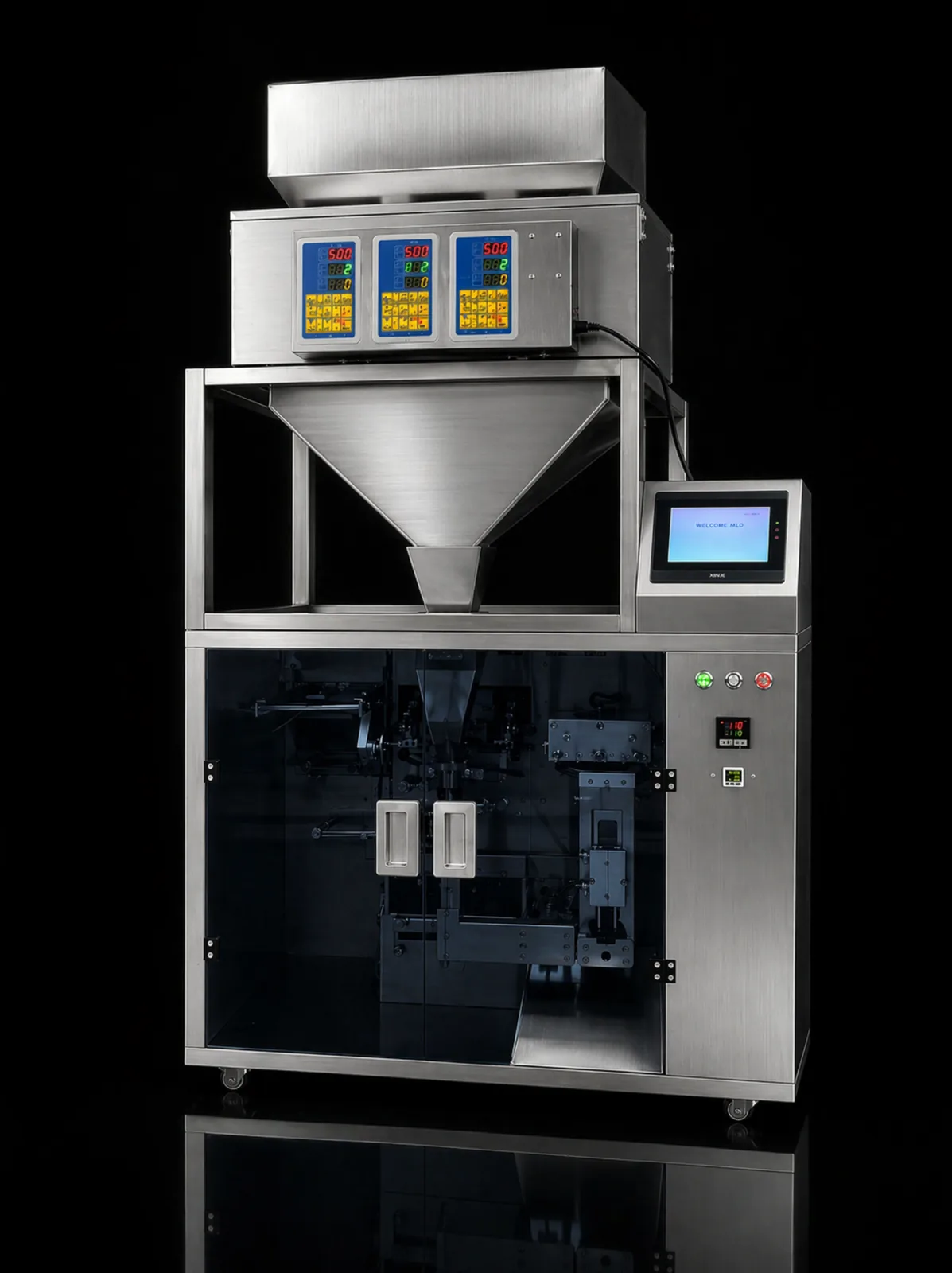
Tell us what you need to pack — product, dose, sachet size and target output.

Product feed, controls, coding, inspection and discharge

Sachet Packing Line Integration Guide

Connect the sachet machine to product feed, coding, inspection and downstream equipment through a defined mechanical, electrical and control interface schedule.

Integrated VFFS sachet packaging line with upstream and downstream equipment

Define the line boundary before selecting interfaces

List every item from product preparation to accepted finished-pack discharge: mixers or holding tanks, pumps, hoppers, feeders, the sachet machine, coder, inspection, reject, conveyor, counter, collator and any cartoning or case equipment. State what is included, what is existing and who owns each interface.

A clear boundary prevents gaps such as an unpowered transfer, missing low-level signal, incompatible discharge height or a downstream machine that cannot accept linked sachet strips. Use one controlled layout and interface schedule for all suppliers.

Integrate product feed with dosing and machine state

Liquid feed may involve a tank, pump, pressure control, agitation, temperature management or recirculation. Powder feed may use manual loading, screw transfer or vacuum conveying; granules may use elevators or controlled hoppers. The selected method changes the condition presented to the filler.

Define ready, demand, low-level, high-level, refill, fault and dose-complete behaviour. The sequence should prevent empty packs, overfill after a stop and uncontrolled product movement when guards are open or the bagger is not ready.

Treat film, coding and inspection as one timing chain

The film web carries the registration mark, artwork, seal areas and variable-code zone. The coder needs a trigger or encoder relationship; the inspection system needs to know what to check and which pack to reject. A web or pack can travel a significant distance between print, inspection and reject.

Document the pack-tracking method and challenge it at start-up, stop, restart and speed change. For multi-lane webs, identify how lanes are mapped through coding, cutting and rejection.

Design discharge around the actual finished format

Individual sachets, linked strips and stick packs behave differently after cutting. Lightweight packs can overlap, rotate or be affected by static; wet or oily contamination can change friction. Specify discharge height, direction, pitch, orientation and whether packs need counting or grouping.

The downstream machine must accept the peak and normal flow, including restart accumulation. Define what happens when the conveyor, counter or cartoner stops: immediate bagger stop, controlled run-out, buffer or another agreed response.

Write an interface and stop-state schedule

For every machine, list inputs, outputs, signal meaning, healthy state, timing, cable responsibility and response to loss. Include emergency-stop or safety interfaces only within an approved engineered architecture; ordinary control handshakes must not be treated as safety functions.

Record the intended states for start-up, normal run, product low, film low, coder fault, inspection fault, downstream stop, guard opening, emergency stop and power restoration. Recovery is part of the process and should avoid untracked or incorrectly coded packs.

Integrate quality control with a physical reject path

A detection device is useful only when the affected pack can be identified and controlled. Define detection point, pack tracking, reject mechanism, reject confirmation, reject bin access, full-bin response and how a failed reject is handled.

Some quality checks remain sampled or offline. The line specification should distinguish automatic controls from manual sampling and record the evidence expected at factory and site acceptance.

Use data interfaces only where the business process is defined

Recipe selection, batch codes, production counts, alarms and quality results can be exchanged with other systems, but the owner, source of truth and validation method must be agreed. Avoid broad requests for “Industry 4.0” without named data, purpose and acceptance criteria.

Keep critical machine operation independent of unreliable external services where appropriate. Define user permissions, change control, time synchronisation, data retention, network responsibility and cyber-security requirements with the site’s competent IT and controls teams.

Integration schedule for quotation and acceptance

MechanicalFootprints, heights, direction, transfer points, access, guarding boundaries, supports and change-part removal space.
ProductFeed connection, pressure or level range, refill rate, return/recirculation, dust/extraction and cleaning/drain-down.
PackDischarge height, format, orientation, pitch, strip/single setting, accumulation and downstream capacity.
ControlsReady/run/fault/demand signals, timing, stop and restart states, cable/termination responsibility and network interfaces.
CodingData source, trigger/encoder, code area, printer-ready state, change control, verification and fault response.
Inspection/rejectDetection, pack tracking, lane identity, reject device, confirmation, containment and challenge tests.
UtilitiesElectrical, compressed air, extraction, network and process-service connection points and isolation.
AcceptanceIntegrated run case, normal events, induced faults, accepted output, evidence, open-action ownership and retest rules.

Buyer questions

Frequently asked questions

What equipment is usually included in a sachet line boundary?

Potential items include product preparation/feed, the filler and bagger, coder, inspection, reject, discharge conveyor, counting/collation and secondary packaging. Define the actual scope in writing.

Why is product-feed integration important?

Feed pressure, hopper level, refill and transfer method can change product condition and dose stability. The bagger and filler need coordinated demand and fault states.

How should a downstream stop affect the sachet machine?

The response depends on available buffer, pack tracking and product/film behaviour. Define and test controlled stop, run-out and restart states for the complete line.

Does a checkweigher or camera automatically solve quality control?

No. Detection must be linked to pack identity, a verified reject path, reject confirmation and a defined response when rejection fails.

What is an interface schedule?

A controlled list of mechanical, product, electrical, signal, network and responsibility details between machines. It gives suppliers and the site one basis for design and acceptance.

Should emergency stops be connected using ordinary PLC signals?

Safety functions require an engineered safety architecture and competent assessment. Ordinary control signals must not be assumed to provide a safety function.

What should be tested during integrated acceptance?

Test normal running plus agreed refill, reel/code change, inspection challenge, downstream stop, restart, reject and fault states using declared product and film.

Prepare a useful machinery enquiry

Define the complete line boundary and every interface before suppliers finalise their scope

Send the product, target dose, sachet dimensions, film details, required output and site constraints. Lancing Ltd will review the application and identify the practical machine route and trial inputs needed before quotation.

Control-interface questions

Questions to resolve before several machines are treated as one line

Where should the control boundary between machines be written down?

Record the control boundary in the line functional description, interface schedule and acceptance test so every ready, demand, stop, fault and reset signal has an owner.

A drawing that shows only mechanical positions is not enough. The documentation should state which machine leads the line, how safe stops differ from process stops and what an operator must do to restart.

Connect discharge behaviour to downstream controls.

What should happen when the coder or inspection system is not ready?

The required response should be defined before build: prevent production, stop in a controlled position, divert affected packs or create a traceable hold condition.

Allowing packs to continue without a valid code or inspection decision can create an untraceable quality gap. Test loss of ready, fault, consumable-low and recovery states during FAT or integrated commissioning.

Specify coding status and verification logic.

How should product-low and film-end conditions affect the line?

These conditions should trigger a controlled response that protects dose integrity, avoids empty packs and prevents downstream equipment from counting incomplete production.

Define warning and stop thresholds, what happens to packs already in process, and how the line is primed after replenishment. Multi-lane systems may need lane-specific as well as common responses.

Include replenishment states in output testing.

Why should discharge accumulation be tested before handover?

Accumulation changes pack orientation, static behaviour, back pressure and restart flow, so an apparently stable single machine can become unreliable when the downstream line pauses.

Test the declared stop duration, maximum accumulation and controlled restart with the production pack. Confirm that rejects remain identifiable and that no packs are damaged or double-counted.

Plan the complete sachet discharge test.

Turn the answer into a testable machine brief

Send the product, finished sachet and operating conditions behind the question

Include representative product, dose range, sachet dimensions, film or artwork data, required accepted output and any cleaning, coding, inspection or line-integration requirements. Lancing Ltd can then assess the machine route against the real production case.

Liquid line boundary

Water sachets need an upstream and downstream scope

Separate potable-water treatment and hygienic supply from sachet forming and filling, then define collection, drainage, counting and secondary packing after the cutter.

Open the drinking-water sachet project guide.

Powder line boundary

Dust risk can extend beyond the filler

Bag opening, transfer, hopper refill, extraction, reject handling and cleaning can all affect the competent DSEAR assessment and the final equipment boundary.

Open the powder dust and DSEAR guide.

Call 01494 623015 Get my machine recommendation