 LUFS200D1
Liquid VFFS Sachet Filling Machine
Compact piston-pump VFFS platform for sauces, syrups, gels and other flowable products.
5–100 mlPiston pumpBack / 3-side / 4-side
View machine details
Rotary premade-pouch system with twin piston-pump filling for larger liquid and paste packs.

Machine overview
The LUAFS03 uses ready-made pouches rather than forming packs from roll film. The rotary machine indexes each pouch through pick-up, opening, filling and sealing stations, supporting premium pack formats and larger liquid doses.
Published specification
| Dosing system | Twin piston-pump filling heads |
|---|---|
| Reference fill range | Approximately 200–1000 ml, customisable |
| Indicative output | Approximately 20–40 pouches per minute |
| Reference pouch width | 100–220 mm |
| Reference pouch length | 120–350 mm |
| Controls | PLC and touchscreen |
| Pouch opening | Suction-cup opening system |
| Approximate machine size | 2450 × 1450 × 2080 mm |
| Power and supply | Approximately 4 kW; 380 V, 50 Hz |
Reference figures are configuration-dependent and must be confirmed for the product, pack and utilities.
Configure the line
Performance validation
Target output and dose repeatability are affected by product flow, environmental conditions, sachet length, film sealing window, changeover and quality-control settings. Supply representative product and production film for a meaningful test.
Related machinery
LUFS200D1Compact piston-pump VFFS platform for sauces, syrups, gels and other flowable products.
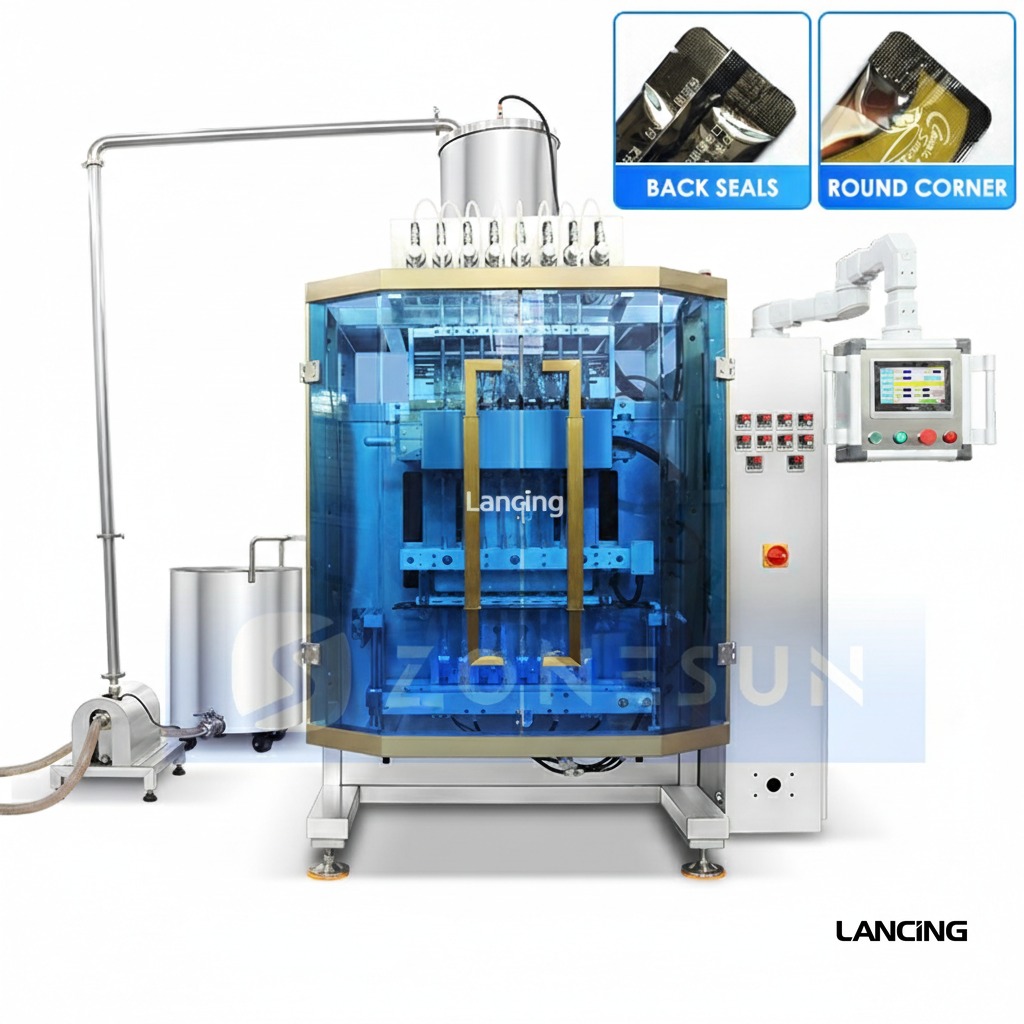 LU-FSMP8
High-output multi-lane VFFS system with independent magnetic-pump dosing for narrow liquid sachets.
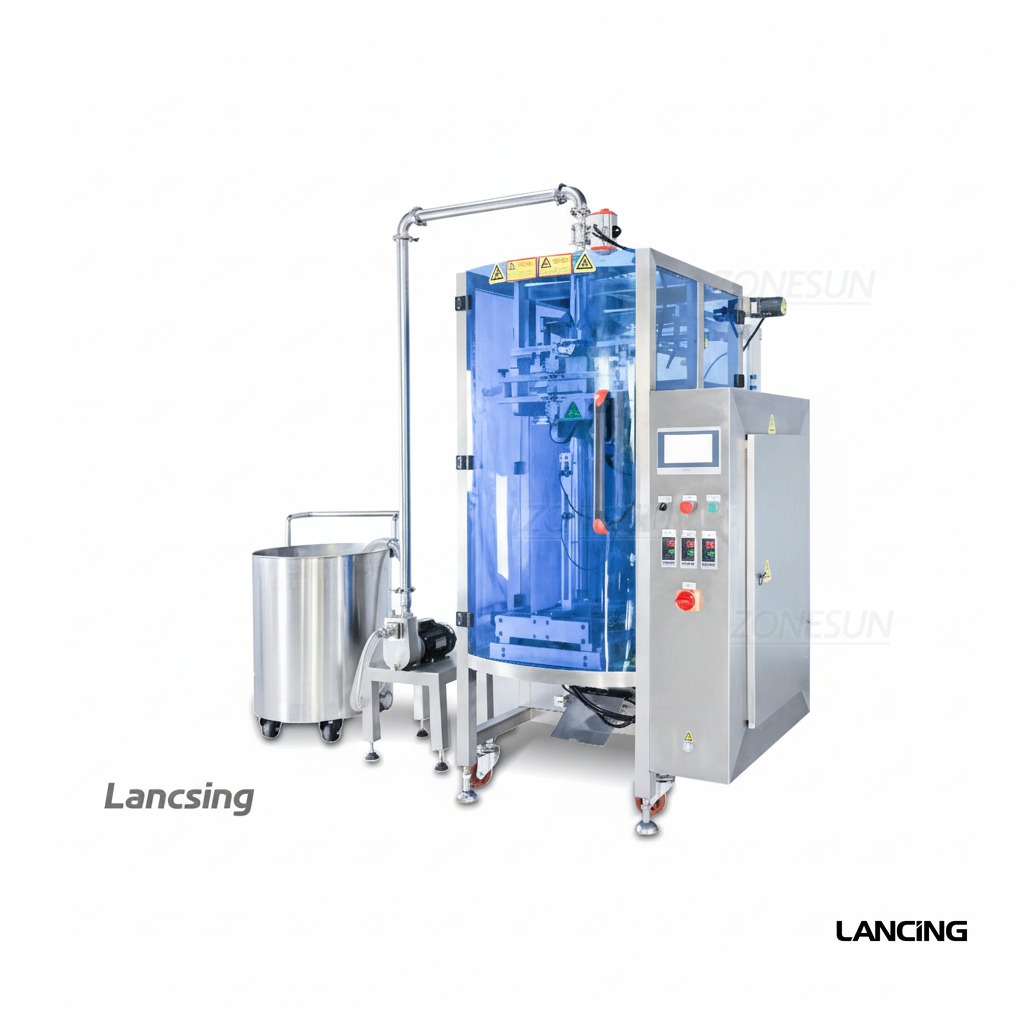 LU-420GSY
Automatic pump-fed VFFS machine for larger liquid and paste sachets or bags.
Common questions
It fills and seals flexible packs but does not form them from film. It is included as a comparison option for projects considering larger or more complex pouch formats.
Representative production pouches are essential. Material, stiffness, zipper position, gussets, dimensions and print tolerances all affect handling.
A suitable pump and valve arrangement may accommodate particulates, but piece size, distribution, product temperature and sealing contamination must be tested.
Tell us about your product and pack
Send the product, target dose, sachet dimensions, film and required output. Lancing Ltd will review your application and recommend a practical machinery route before a detailed quotation.
Production specification for LUAFS03
The LUAFS03 uses a rotary pick-open-fill-seal sequence with twin piston-pump dosing. Pouch stiffness, curl, opening force, zipper or gusset location and top-seal consistency can affect performance as much as the liquid or paste being filled.
A pouch that is not fully opened can cause product on the seal or an incomplete dose. Trials should distinguish pouch-presentation failures from pump or seal faults so the machine and pouch specifications can be corrected at the right source.
The twin-piston arrangement should be checked for dose balance and clean cut-off. Pouch support, filling depth and headspace must keep the zipper and top-seal area clean while the rotary stations move the pack.
| Pouch handling | Record pickup, opening and presentation failures by pouch batch and size. |
|---|---|
| Dose balance | Measure output from each filling head across the required volume range and product condition. |
| Seal cleanliness | Inspect the top seal, zipper area and any wrinkles or product contamination before applying the agreed integrity test. |
| Format change | Demonstrate adjustments and change parts for the commercially important pouch sizes and confirm repeatable setup. |
| Accepted output | Count conforming opened, filled and sealed pouches and state pouch, product, code and inspection conditions. |
Conventional small flat packs can be formed more directly from reel material on a VFFS sachet machine. Select the LUAFS03 when a converted pouch feature or larger format has genuine commercial value and the additional pouch-handling process is justified.
A useful trial record identifies the product and film batches, dose setting, sachet dimensions, forming and sealing parts, coding setup, operating speed, stops, rejected packs and quality checks. Retained samples should be labelled so results can be traced to the lane, recipe or test condition where relevant.
The final quotation and acceptance schedule should distinguish indicative catalogue references from the values that will be demonstrated with the agreed product, pack and utilities.
Additional buyer questions
Converter variation can change curl, stiffness, static and opening. More than one representative batch helps define the pouch tolerances the machine must accept.
The pouch design may allow it, but zipper position, opening, filling clearance and the top heat-seal area must be checked with actual samples.
Agree separate categories for pickup, opening, dose and seal failures. Accepted output should count only conforming finished pouches under the declared conditions.
No. Pouch handling, fill volume, viscosity, seal time, coding and inspection affect the practical result. The critical combinations should be tested.
Define the project around your product and pack
Provide representative product, every required dose and sachet size, film details, accepted output, utilities, cleaning and inspection requirements. Lancing Ltd can then confirm whether the LUAFS03 is the correct starting point and define the trial scope.