
The direct answer
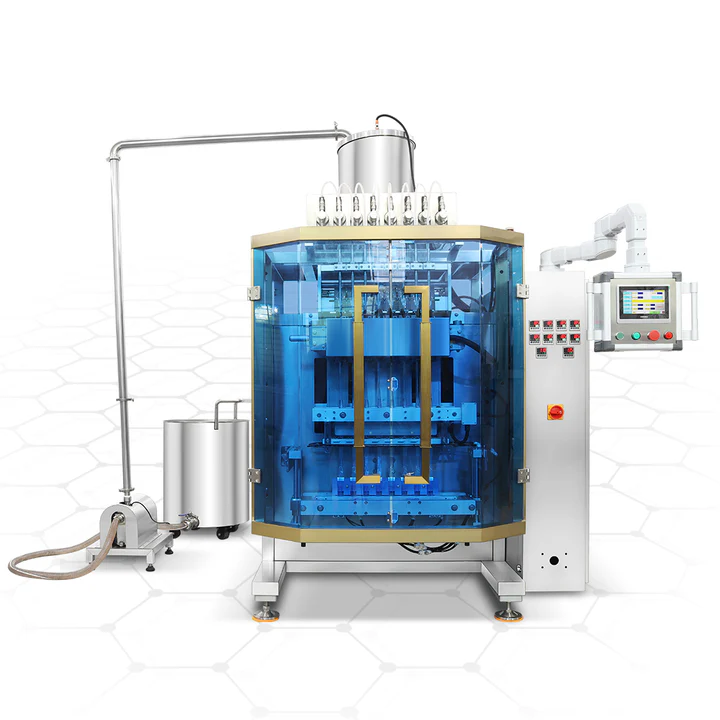
A vertical form fill and seal (VFFS) sachet machine unwinds a film web, controls its position, forms the pack, meters product through the correct filler, makes the required seals, then cuts or perforates the finished sachet. The stages overlap in a timed cycle, so film, dosing, sealing, coding and discharge must be specified as one production system.
The machine architecture is only the starting point. A liquid pump, paste piston, powder auger or granule weigher changes the feed arrangement and the time needed to deliver product without contaminating the sealing area. Printed film adds registration control, while multi-lane machines repeat the sequence across several parallel pack positions.
What are the main stages in a VFFS sachet cycle?
The main stages are film unwind, web guidance, forming, longitudinal sealing, product dosing, transverse sealing, cutting or perforation, and discharge.
- Unwind and guide: the reel feeds film through controlled rollers and tension devices.
- Register: plain film runs to a set length; printed film is corrected from its registration mark.
- Form: the web is folded or drawn around the forming set to create the pack geometry.
- Longitudinal seal: a fin, lap or side-seal arrangement closes the film in the machine direction.
- Dose: the selected filler delivers liquid, paste, powder, granules or pieces into the open pack.
- Cross seal and cut: the jaws close the top of one pack and the bottom of the next before the web is cut or perforated.
- Discharge: individual sachets or linked strips leave for inspection, counting or secondary packing.
The exact order and overlap vary by machine design, but the accepted pack depends on each stage arriving in the correct position and condition.
When is the product dosed relative to the cross seal?
Product is normally dosed after the lower boundary of the pack has been created and before the upper cross seal closes, with enough time and internal space for the product to settle clear of the jaws.
That timing is product dependent. A low-viscosity liquid may need controlled nozzle closure to stop drips; a paste may need time for a tail to break; a powder may need a managed drop to limit dust; granules may bounce or bridge across a narrow opening. The usable sachet volume, headspace and nozzle position therefore influence both the pack drawing and the cycle.
How does printed film stay aligned with the cut?
A registration sensor, often called a photocell or eye-mark sensor, detects a printed reference mark so the controls can correct film advance and keep the artwork, cross seal and cut in the intended relationship.
The mark must have suitable contrast, size and position for the sensor, while the print repeat must match the mechanical pack length. The approved web drawing should show the registration mark, seal bands, cut, tear notch, code area and lane map. A graphic artwork approval does not by itself confirm that the web can be controlled by the machine.
What changes between liquid, powder and granule machines?
The forming and sealing platform may be related, but the dosing device, product feed, hopper or tank, cleaning access, cut-off behaviour and contamination controls change with the product.
| Product group | Typical engineering focus | Evidence needed |
|---|---|---|
| Liquids | Viscosity, foaming, pressure, temperature, nozzle closure and drip control | Representative product through start-up, refill, pause and restart |
| Pastes | Stringing, particles, temperature, piston/valve geometry and clean cut-off | Repeated doses into the intended pack opening and headspace |
| Powders | Bulk density, aeration, bridging, dust, agitation and refill disturbance | Production transfer and low-level/refill conditions |
| Granules | Flow, segregation, fragility, piece size, weighing or volumetric control | Full feed and drop path with retained product samples |
Which parts normally change for a new sachet format?
A new format may require a forming set, film-width change, seal-jaw or cutter tooling, nozzle or product tube, recipe, photocell position, coding layout and discharge adjustment.
Some changes are recipe-led, others use change parts, and a different web or seal pattern may require dedicated tooling. List the complete launch and future format matrix before quotation so the supplier can state what is included, what must be changed and what falls outside the proposed platform.
Sachet cycle control table
| Stage | Controlled input | Useful acceptance evidence |
|---|---|---|
| Film feed | Web, reel, tension, tracking and print repeat | Stable length, registration and wrinkle-free seal areas |
| Dosing | Product condition, feed level, dose and filler setup | Traceable dose samples through declared operating states |
| Sealing | Film, jaw condition and approved process settings | Clean, aligned seals passing the agreed pack test |
| Coding | Content, position, trigger, substrate and verification | Readable, correct code with defined fault response |
| Discharge | Singles/strips, orientation, static and downstream demand | No damage, loss, double count or unidentified reject |
Information to provide
- Representative product and the range of viscosity, bulk density, particles, temperature, foam or dust seen in production.
- Target dose, permitted tolerance and the measurement method used to release packs.
- Finished sachet drawing, seal pattern, opening feature and any strip or perforation requirement.
- Film construction, web/reel data, print repeat, registration mark and coding area.
- Required accepted output, operating pattern, line interfaces and downstream pack presentation.
- Cleaning, product change, utilities, installation and acceptance-test requirements.
Safety context: HSE guidance for packaging machinery identifies guarding and safe intervention as important considerations around forming and cutting equipment. Final machinery safety, installation and operating procedures require a competent application-specific assessment and the supplied machine documentation. Read HSE packaging-machinery guidance.