
Temperature-sensitive liquid and paste projects
Hot-Fill Sachet Packing Machines
A hot-fill sachet project must control the product condition from the supply vessel to the filled pack. The actual temperature at the nozzle, temperature-dependent viscosity, film seal window, operator protection and downstream cooling all need to be tested together.
Direct answer
Can a sachet machine fill a hot product?
Yes, when the selected filler, product-contact path, hoses, valves, seals, guarding and film are suitable for the declared operating case. There is no universal maximum hot-fill temperature for all products and sachet films. Lancing must review the actual product temperature profile, viscosity, hold time, cleaning method, pack material and trial evidence before confirming suitability.
- State the normal and worst-case product temperature at the supply vessel and filling nozzle
- Explain how viscosity, particles, foaming or stringing change as the product cools
- Provide production-intent film and the converter’s sealing information
- Define cooling, collection, inspection and secondary packing after discharge
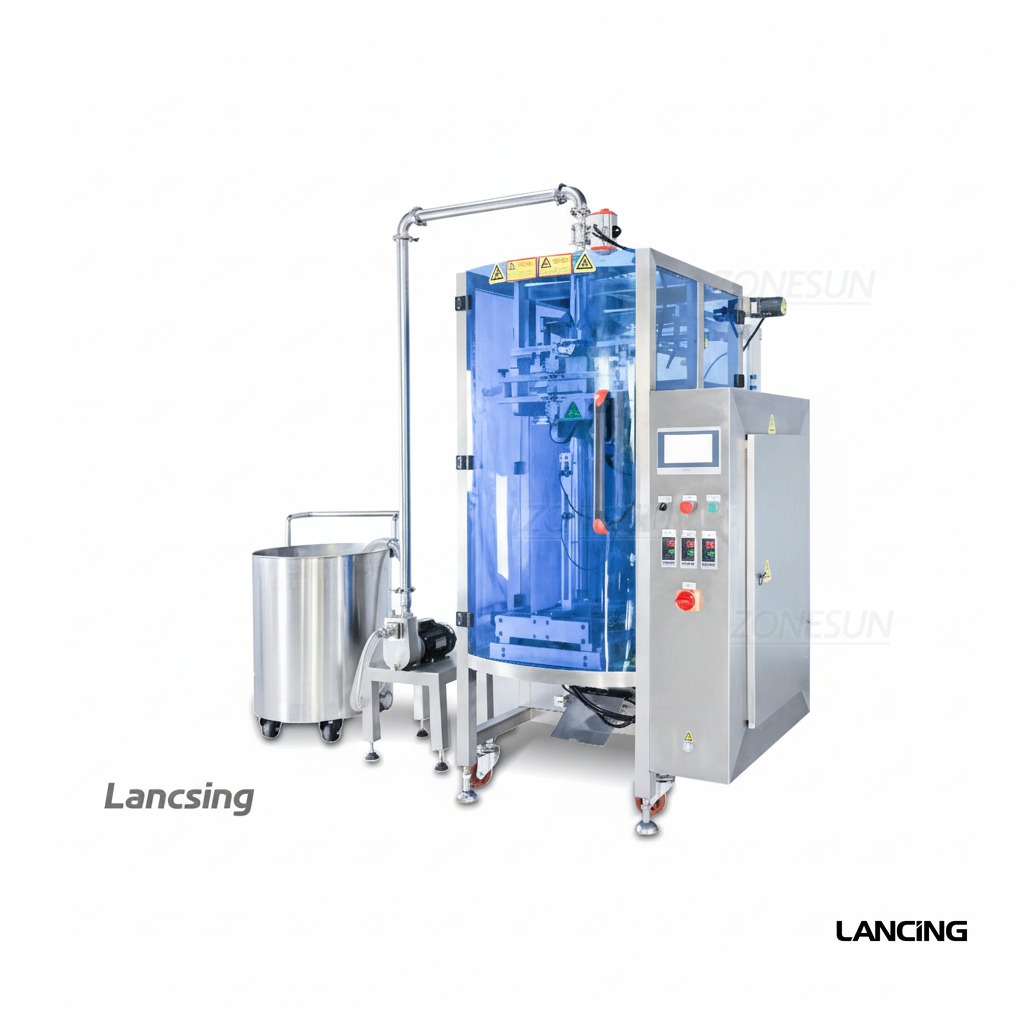
Map the real product temperature through the line
Record temperatures at preparation, transfer, buffer vessel, filler inlet and nozzle—not only the kettle set-point. Heat loss through transfer pipework and standing time can change viscosity and dose behaviour. The specification should state the normal range, start-up condition, allowable pause time and the action required if the product leaves its approved window.
For products that set, skin, separate or thicken as they cool, define the minimum usable condition and how the line will be safely emptied or cleaned after an interruption.
Specify heated product feed, agitation and recirculation
A heated or insulated hopper may maintain local temperature, while an agitator can help control separation or uneven heat distribution. A transfer pump or recirculation loop may be needed when the production process cannot gravity-feed the filler consistently. These functions must be included explicitly in the supply boundary; they should not be assumed from the phrase “hot fill”.
Confirm product residence time, level-control behaviour, replenishment method and whether agitation could damage particles or alter texture.
Select the dosing path from hot-product behaviour
The pump, valve and nozzle must meter the product at its working temperature and stop cleanly before the seal closes. Stringing, dripping, foaming and suspended pieces can contaminate the transverse seal. Nozzle cut-off, fill timing, headspace and any suck-back function should be tested with the actual product rather than judged from cold-water trials.
Confirm the film and sealing window at the declared fill condition
Hot product can warm the film, increase vapour or condensation and reduce the time available before the cross seal closes. The film converter’s information, pack drawing and machine trial should establish a workable combination of temperature, pressure and dwell. Check seal continuity, distortion, product contamination, leakage and appearance after the pack has cooled.
For food applications, the packer should hold evidence that the packaging is suitable for food contact and for the intended use. Shelf-life and product-safety validation remain the responsibility of the food business.
Plan cooling and downstream handling
A freshly filled sachet may be warm, flexible or vulnerable to seal damage. Define discharge height, support, cooling time, accumulation, leak inspection, counting and case packing. Do not size the downstream system from an isolated machine cycle rate: use the accepted saleable output after normal stops, checks and cooling constraints.
Set hygiene and machinery-safety boundaries
Hot product, heated surfaces, moving sealing jaws and pressurised transfer systems require a site-specific machinery and process risk assessment. Guarding, insulation, emergency stops, isolation, drainage and safe access for cleaning must be reviewed for the complete installed line. General guidance does not replace the machine manual, the food business’s safety-management system or competent assessment of the actual process.
Representative hot-fill trial checklist
- Provide the actual product, production-intent film and dimensioned sachet drawing.
- Run at the normal and declared worst-case filling temperatures.
- Include start-up, steady operation, replenishment, a planned pause and restart.
- Sample dose, seal integrity, leakage, code, cut and finished appearance after cooling.
- Record interventions, rejects and the temperature behind each sample set.
- Agree the accepted-output calculation and retain labelled samples where required.
Information needed for a useful quotation
| Product | Recipe description, temperature profile, viscosity range, particles, foaming, stringing and separation |
|---|---|
| Process | Supply vessel, transfer distance, replenishment, agitation, recirculation, hold time and cleaning method |
| Pack | Dose range, sachet drawing, film structure, seal layout, code, notch/perforation and cut |
| Downstream | Cooling, collection, inspection, counting, cartoning or case-packing requirement |
| Acceptance | Dose method, leak/seal test, visual criteria, sampling and declared accepted-output case |
Official UK guidance requires food businesses to manage food safety and use packaging suitable for food use. Processing and packaging machinery also requires appropriate risk control. See GOV.UK food hygiene guidance, GOV.UK food packaging guidance and HSE processing and packaging machinery guidance.
Buyer questions
Questions about hot-fill sachet packing
What temperature can a sachet filling machine handle?
There is no single limit that applies to every filler, hose, valve, film and product. Provide the actual temperature at the nozzle and the full temperature profile so the complete configuration can be checked and trialled.
Does a hot-fill project always need a heated hopper?
No. The need depends on heat loss, residence time and how product behaviour changes with temperature. Some projects need heating, insulation, agitation or recirculation; others need only a controlled upstream supply.
Can hot sauce with particles be filled into sachets?
Potentially, but particle size, shape, concentration and damage tolerance must be matched to the pump, valve and nozzle. Representative product trials are essential.
Why test seals after the sachet has cooled?
The finished pack can change as product and film cool. Post-cooling checks show whether seals remain continuous, undistorted and leak-resistant under the condition in which packs will be handled and supplied.
Who is responsible for food-safety validation?
The food business remains responsible for its food-safety management, packaging suitability, process validation, labelling and release controls. Machinery trials provide engineering evidence but do not replace those duties.
Prepare a hot-fill machinery enquiry
Send the product, temperature profile, sachet and film
Approximate information is enough to start. Lancing will identify the missing process, trial and integration inputs before recommending a machinery route.
Agree the hot-fill assessment through the final pack condition
For a hot-fill sachet project, ask the responsible product team to define the intended process conditions and the point at which the finished pack will be assessed. The equipment trial should record the relevant conditions along the proposed route and identify the film used. Include the planned handling after sealing and any required holding or cooling stage. Keep machinery acceptance separate from any wider product-process validation that the product owner must arrange.
- Process references
- Supply the intended product and film information and ask the supplier to identify assumptions that require further technical review.
- Trial timeline
- Record the sequence from product supply to sealed-pack assessment, with samples tied to the relevant operating conditions.
- Interrupted run
- Ask the project team to define the approved response to a stop, including disposition of product and packs affected by the interruption.
Does a successful hot-fill sachet demonstration establish shelf life?
Do not assume that it does. Ask the responsible product team to define any separate validation required. The machinery trial should state precisely which dosing, film, sealing and handling outcomes it assessed.